Fine Print Fanatics: The Readers Treating Album Credits Like Sacred Texts
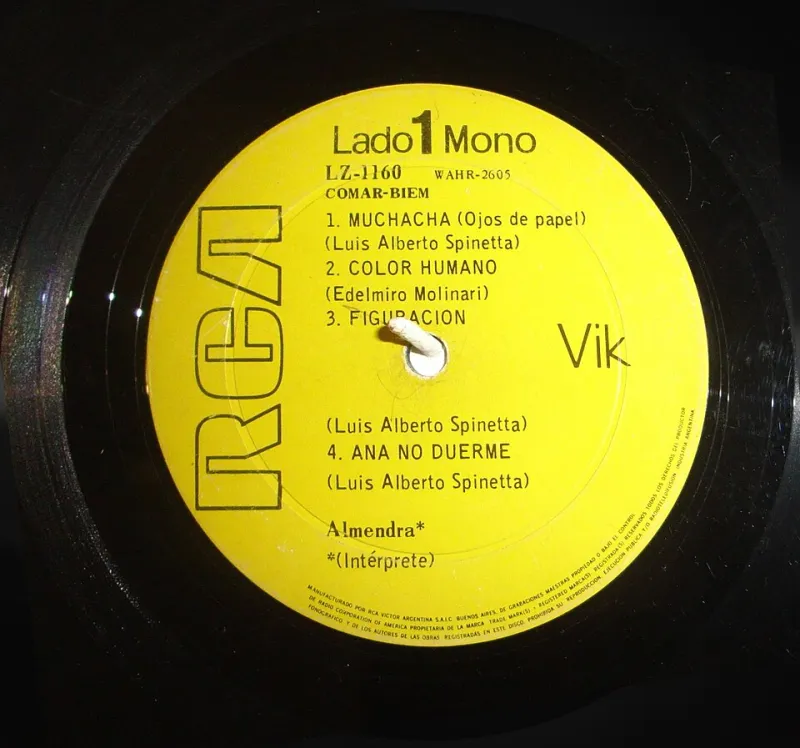
Photo: Disco de vinilo - Almendra.jpg: Banfield derivative work: Clusternote, Public domain, via Wikimedia Commons
Most people crack open a vinyl sleeve, glance at the tracklist, maybe squint at the production credits for half a second, then put the record on. That's normal. That's fine. But there's a whole other tier of listener who will spend three hours cross-referencing a "special thanks" section against a musician's known relationships, pulling apart the syntax of a single dedication to figure out who got cut from the acknowledgments between the recording session and the pressing.
These people exist. They've been building something — quietly, methodically — and it's more rigorous than most music journalism you're going to read this year.
What They're Actually Doing
Call it paratextual analysis if you want the academic framing. Call it liner note archaeology if you want something that actually sounds like what it is. Either way, the practice is the same: treating every piece of physical album packaging — the credits, the thank-yous, the sample clearances, the font choices, the photo placement, the deliberate omissions — as a layered document carrying as much meaning as the music itself.
The community is scattered across Discord servers, niche subreddits, and a few long-running forums that most people forgot existed. There's no central hub, no verified institution backing any of this. What there is, though, is a shared methodology that's been refined over years of collective obsession. Some members come from literary criticism backgrounds. Some are just fans who noticed one too many things that didn't add up. A lot of them started by asking a simple question — why is this person thanked here and not there? — and never really stopped.
The work tends to cluster around specific artists with dense, intentional packaging. Hip-hop albums from the '90s and early 2000s get heavy rotation, partly because that era treated the physical insert as an extension of the artistic statement, and partly because the sampling culture of that moment left fingerprints everywhere in the credits if you knew how to read them. Certain indie rock records from the same period get similar treatment. So do a handful of contemporary releases from artists who clearly still care about what the sleeve says.
The Credit as Evidence
One of the core practices involves mapping production credits against known industry relationships to surface what a record is actually saying about its own making. When an artist who has publicly feuded with a former collaborator suddenly lists that person under a vague "additional contributions" tag rather than a specific role, that's not an accident. When a co-writer credit disappears between the digital release and the physical pressing, somebody made a decision. These readers want to know why.
Sample sourcing is another major thread. The formal credits required by copyright law are often bare minimum — a song title, a publisher, a percentage. But the way those clearances are listed, and what isn't listed, can tell you a lot about how a production was assembled and who got paid fairly versus who got buried. Some of these analysts have developed informal databases cross-referencing credited interpolations against known original recordings, flagging discrepancies that labels and music publications rarely bother to chase.
Dedications get their own entire branch of analysis. The thank-you section of an album is one of the few places in commercial music where an artist speaks in something close to an unmediated personal voice. Who's first. Who's last. Who gets a full sentence versus a name-drop. Whether family members are listed by nickname or formal name. Whether a romantic partner appears at all. For the serious readers in this community, these aren't trivia — they're timestamps. A record of where an artist was emotionally at the moment they signed off on the final proof.
Why Major Outlets Miss This
Here's the honest answer: physical packaging is inconvenient to analyze at scale, and most music criticism has migrated entirely toward streaming-native content, where the paratext barely exists. You can't click on a liner note. You can't embed it in a newsletter. The economics of music media don't reward the kind of slow, close reading that this work requires.
There's also a gatekeeping issue that runs the other direction. Academic musicology has frameworks for this kind of analysis, but those frameworks rarely escape the journal paywall, and they're usually applied to canonical works rather than contemporary releases. The people doing this work in online communities aren't citing Derrida in their Discord threads — they're building their own vocabulary from scratch, through argument and iteration, which is honestly how most useful critical frameworks get built anyway.
What's interesting is that some of these readers have started producing written work that's genuinely difficult to dismiss. Long-form posts that trace the production genealogy of an entire discography through credit changes alone. Annotated scans of inserts with marginal commentary that reads like a graduate seminar exploded onto a Google Doc. Some of it circulates widely enough that artists and their teams have quietly acknowledged it — not always publicly, but in ways that suggest the work is being read by people who were actually in the room.
The Omission as Statement
Probably the most sophisticated thing this community does is read what isn't there. An album that credits every collaborator in exhaustive detail except one notable session musician. A producer who worked on six tracks but is thanked for none of them. A label executive who appears prominently on the first three records and vanishes entirely from the fourth.
Silence in a liner note isn't neutral. It's a choice made by someone with something to say — or something to avoid saying. These readers have developed a kind of negative-space literacy, a trained eye for the shape of what got left out. It's the same skill a good editor uses when they notice what a writer keeps circling without naming, and it produces the same kind of uncomfortable, clarifying insight.
The major music press isn't going to do this work. The algorithms definitely aren't. So it gets done here, in the margins of the margins, by people who care enough to read the fine print nobody asked them to read.
That's the move. That's always been the move.